Long before the antahkarana was described as a bridge of light or a thread of consciousness, its essential geometry was already present in the ancient symbol of the caduceus.

Two serpents spiral upward around a central rod rising toward a winged crown. The serpents cross the rod five times before reaching the wings, each crossing corresponding to one of the five spinal chakras.
This is not merely a medical emblem but an archetypal diagram of the human ascent: the central rod as the vertical axis of the spine, the twin serpents as the polar currents of the personality, the wings as the awakened Ajna, and the luminous point above as the thousand‑petalled lotus. The caduceus is another expression of the antahkarana in mythic form—one of the earliest symbolic attempts to portray the movement of consciousness from the personality to the higher realm of the spirit.
Seen through the lens of esoteric anatomy, the central rod of the caduceus would correspond to the spinal column, not as a physical structure but as a vertical channel of force. It is the subtle axis along which the five lower chakras are arranged, each one a harmonic node in the rising ladder of consciousness. The rod is the sushumna, the inner staff, the silent pillar that holds the entire human instrument in alignment. It is the architectural line of the bridge itself—the path along which the ascending current must travel.
The Three Head Centers as the Governing Harmonic Intelligence
The five spinal chakras may be visualized as a stretched pentatonic ladder—Root, Sacral, Solar Plexus, Heart, and Throat—arranged not by temperament but by strict petal mathematics. Their vibratory architecture reveals itself as a harmonic column anchored on Heart = G₃. Each chakra occupies its place in the natural series: Root at C₂ (1/3 of Heart), Sacral at G₂ (1/2), Solar Plexus at E₃ (5/6), Heart at G₃ (1), and Throat at C₄ (4/3). This is not a scale in the musical sense but a vertical harmonic spine, a cantus firmus rising through the body in exact proportional steps. The spine becomes a resonant staff, each chakra a fixed harmonic node, each tone a structural necessity rather than a chosen pitch.
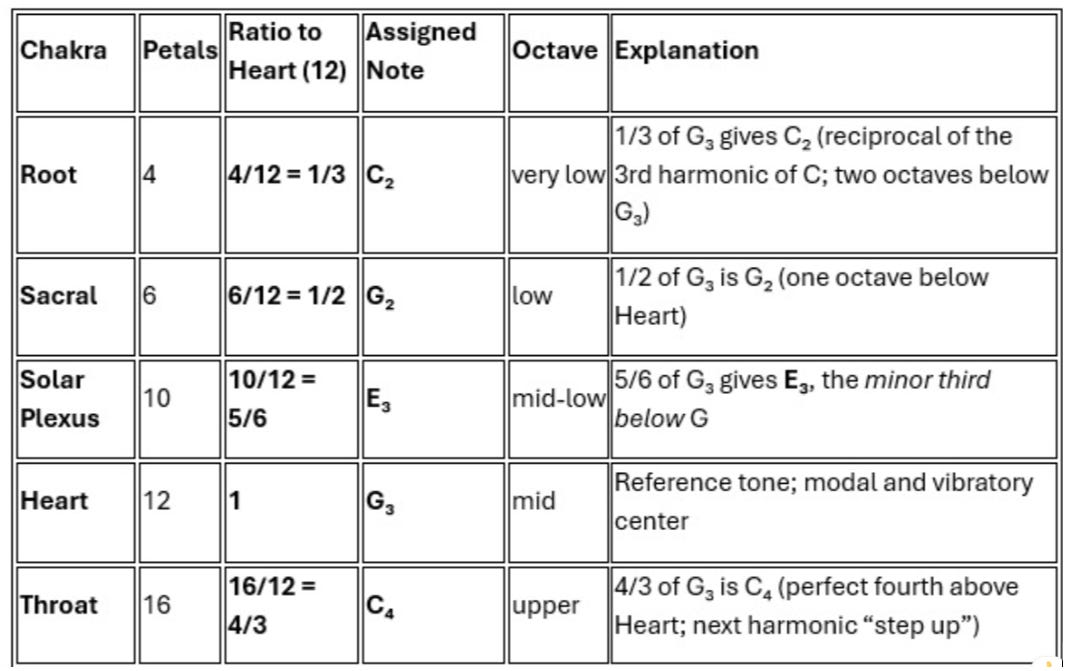
Yet this spinal column does not tune itself. Its coherence depends on the three head centers, which function as the higher regulators of the entire harmonic field. Alta Major, Ajna, and Brahmarandra form a triune intelligence that governs the spinal tones the way a conductor governs an orchestra: not by imposing sound from above but by establishing the conditions under which each instrument can find its true pitch. Alta Major, vibrating at F, anchors the deep intuitive resonance that links the spine to the head; Ajna, vibrating at G, provides the central axis of mental clarity and directional will; Brahmarandra, vibrating at C, opens the vertical channel to the monadic current. Together they form a head‑triad chord—F, G, C—whose intervals create the governing harmonic environment in which the spinal tones must align.
The Ajna center, and specifically the Third Eye within it, acts as the conductor of this metaphoric orchestra. It does not generate the tones; it regulates their relationships. It holds the harmonic blueprint of the entire system and ensures that each spinal chakra vibrates at its correct ratio relative to the Heart. When the Third Eye is active, the five spinal tones lock into their natural positions. The spine becomes a single harmonic ladder, tuned from above, each center resonating as a partial of the greater head‑triad chord.
This may be the deeper meaning of a “soul-infused personality”: the head centers not overpowering the spine, but tuning it. They establish the harmonic conditions under which the lower centers can express their inherent mathematics without distortion. When the head triad is inactive, the spinal tones drift. But when the head triad is awake, the entire column resolves into a single harmonic architecture: a vertical resonance from C₂ to C₄, governed by the F–G–C triad above, and conducted by the Third Eye as the integrating intelligence.
In this state, the human being becomes a tuned instrument. The spine is the resonant body, the head centers the harmonic regulators, and the Third Eye, the point of coherence through which the entire system is held in alignment. The five spinal tones no longer behave as isolated nodes but as a unified harmonic ladder, each tone a necessary partial of a larger chord, each vibration a structural expression of the soul’s mathematics. The body becomes music—not metaphorically, but architecturally—a self-healing instrument “making sound from within,” tuned from above, resonating from below, and held in equilibrium by the luminous intelligence of the Ajna conductor
The Chakras as Voltage Regulators of the Pranic Field
In the esoteric physiology, the human energy system may be best understood as an electrical architecture whose stability depends on the quantity of prana entering the organism as well as on the quality of its regulation. The spleen serves as the primary inlet of vitality through which solar and planetary prana enters the etheric body; the nadis form the subtle wiring that distributes this current throughout the interstitium long before it reaches the bloodstream; and the chakras function as the true regulators of the system, transforming the raw inflow into differentiated voltages that sustain the local pranic field.
Each center receives the circulating current, steps it up or down according to its inherent ray quality, and modulates it under the impress of emotional and mental states. The center does not generate energy; it governs the equilibrium between inflow, transformation, and radiatory distribution. Its task is not to supply power but to maintain coherence.
Psychological life enters this architecture not by altering the supply of prana but by altering the regulatory capacity of the centers. Inhibition generates retention; overstimulation generates turbulence; and both conditions weaken the coherence of the etheric pattern that underlies the physical cells. Certain diseases, like cancer and epidemics, are not primarily psychological in origin but arise from planetary and racial conditions inherent in substance itself. These “seeds” exist within the very fabric of matter, awaiting only the appropriate voltage conditions to become active. The psyche does not create these diseases; it modulates the environment in which they may precipitate.
Bridging Voltage and Harmony
As the voltage‑regulation model clarifies the energetic stability of the centers, a deeper pattern begins to reveal itself: regulation is not merely electrical but inherently harmonic. A center that maintains a stable voltage is a center that holds its pitch; a center that falls into inhibition or overstimulation is a center that drifts sharp or flat relative to the field. The nadic mesh behaves not only as wiring but as a resonant medium, and the chakras act not only as regulators but as harmonic nodes whose frequencies must remain in proportion if the organism is to sustain coherence (health). When the voltage of a center is inadequate, its tone drops out of alignment. Voltage stability is harmonic stability; coherence of current becomes coherence of tone; and the regulation of prana becomes the tuning of the human instrument.
Thus Spake Zarathustra: The Harmonic Dialogue
Strauss’s Thus Spake Zarathustra is chosen here not for its fame but for its musical architecture. No other modern composition renders the ascent from the lower centers to the head triad with such clarity, such harmonic transparency, or such symbolic force.
2001 A Space Odyssey Opening in 1080 HD
When the five spinal chakras are tuned to their strict petal ratios—C₂, G₂, E₃, G₃, C₄—they form a vertical harmonic ladder whose geometry mirrors the natural series. Above it stands the head‑triad chord—F (Alta Major), G (Ajna), C (Brahmarandra)—the governing harmonic intelligence that tunes, regulates, and ultimately redeems the spinal tones. The ascent from the spine to the head is not linear but harmonic, and Strauss’s Zarathustra provides the perfect musical analogue for this vertical awakening.
The opening chords—C–G–C with the oscillation E–E♭ and then E♭–E—correspond to the first task of the path: the alignment of the personality. The minor and major third below G represent the oscillation between the lower emotional nature (E♭) and the purified mental clarity (E). This is the tuning of the Solar Plexus to the Heart, the stabilization of the E₃ tone so that it can resonate cleanly with G₃.
The next chords—C–G–C rising into C–F–A—mark the projection from the spine into the head centers. The perfect fourth from C to F is the natural harmonic bridge between the Throat (C₄) and Alta Major (F). This is the moment when the spinal column hands over its resonance to the head triad. In Strauss, this is the first true sunrise moment; in the esoteric anatomy, it is the first emergence of the spinal current into the domain of the head, leading to the final apotheosis.
The chords C–F–A, D–G–B, and the culminating C–E–G–C are the three great chords of the head triad, bringing the spine chakras into full resonance: C–F–A as the Mother overshadowed by the Holy Spirit (Alta Major); D–G–B as the Son (Ajna) in full radiance; and C–E–G–C as the Father aspect grounding the entire harmonic architecture.
Strauss gives us, in sound, what the esoteric physiology describes in energy: a vertical movement from personality to soul, from the harmonic ladder of the spine to the triadic intelligence of the head, from the first stirring of alignment to the radiant coherence of the antahkarana. It is for this reason that Zarathustra becomes a musical analogue of the inner ascent.
The Heart as the Modal Axis
Every instrument requires a reference tone, and in the human system that tone is the Heart (Agni Yoga). Not by sentiment, but by structure. The ascent cannot begin anywhere but the Heart.
In Theosophical language, the Heart is the seat of the “inner light,” the place where the Ray of the Divine is first perceived, while the Eye—brilliant, penetrating, analytical—sees only the outer shell unless it is opened by the Heart. Blavatsky called these the Doctrine of the Heart and the Doctrine of the Eye, two modes of knowing that mirror the two serpents of the caduceus. The Eye sees form; the Heart perceives essence. The Eye discerns; the Heart unifies. The Eye gathers facts; the Heart recognizes truth. And just as the serpents cannot rise unless they cross at the Heart’s harmonic node, the antahkarana cannot be built unless the personality is first stabilized in the energy of love‑wisdom—the same energy Dante names in the final line of the Paradiso as “the Love that moves the sun and the other stars.”
The Heart is the modal axis because it is the only center capable of holding the lower nature in coherence while opening the higher vision. It is the kernel behind the shell, the inner fire behind the outer light, the one vibration that can tune both the spine below and the head triad above. The Eye of Wisdom opens only when the Heart has prepared the field, and the bridge shines only when its central tone is love.
Discover more from Agni Yoga
Subscribe to get the latest posts sent to your email.